Everyday Magic
Picture someone from two hundred years ago standing beside you while you unlock your phone. You ask the glowing rectangle for the fastest way home, and a calm voice answers. You hold it up and talk to your sister across the country as if she stands in the room. You tap once and a map of the whole planet unfolds in your palm. To that visitor, the scene looks like magic. The tools we treat as ordinary would stop them cold.
Here is the part that still catches me. The same kind of leap keeps happening, only faster. After enough leaps, what feels like science fiction today starts to feel like Tuesday. The next wave of everyday magic sits closer than most of us expect.
If you have ever watched Black Mirror, you have already seen some of that future on a screen. Memory implants. Screens that know your face. Choices that follow you from room to room. The show leans dark on purpose, yet much of the tech itself is not far-off fantasy. Pieces of it already show up in labs, clinics, and phones. The hard part is staying clear-eyed about what arrives next, and aiming it toward healing and building rather than fear.
Ray Kurzweil and the Law of Accelerating Returns
One of the clearest guides I found for watching that pattern is Ray Kurzweil. He is an inventor and a futurist. For decades he has studied how information tools improve, from early computers to music machines to reading machines for people who are blind. In books like The Singularity Is Near and The Singularity Is Nearer, he argues that once a useful tool turns into shareable information, it often stops improving by tiny crawls. It starts improving by doublings. He calls the bigger pattern the law of accelerating returns. Returns means the gains we get from better tools. Accelerating means those gains arrive faster over time, not at a steady crawl.
Kurzweil also writes about something he calls the technological singularity. He uses the word singularity the way physicists use it for a point where the old rules stop describing what comes next. In his telling, it is a future stretch when machine intelligence grows so capable, and so woven into how we invent and solve problems, that change speeds past what today's forecasts can track with confidence. He is not claiming a single magic date on a calendar. He is pointing at a threshold where exponential tools remake the pace of progress itself. The Singularity Is Near and The Singularity Is Nearer are his maps of that idea, written with curiosity and with a long look at the evidence he has gathered.
What Exponential Technology Means
Exponential technology is the name for tools that improve by multiplying, not by adding a little each year. Doubling is the engine inside that idea, so it is worth slowing down for. Doubling means the thing gets twice as good, or twice as cheap, or twice as capable, then twice again, then twice again. The key is the multiply, not the add. Linear change adds the same amount each step. You take thirty steps of one meter and you travel thirty meters. Exponential change multiplies. You double thirty times starting from one meter, and you travel more than a billion meters. Same number of steps. Wildly different distance. Early doublings feel almost invisible. Late doublings rearrange the whole landscape. When people say exponential technology, they mean tools like computers, software, DNA sequencing, weather models, and phone cameras, the kinds of tools that live as shareable information and often follow that multiply path.
The Human Genome Project Was on Time
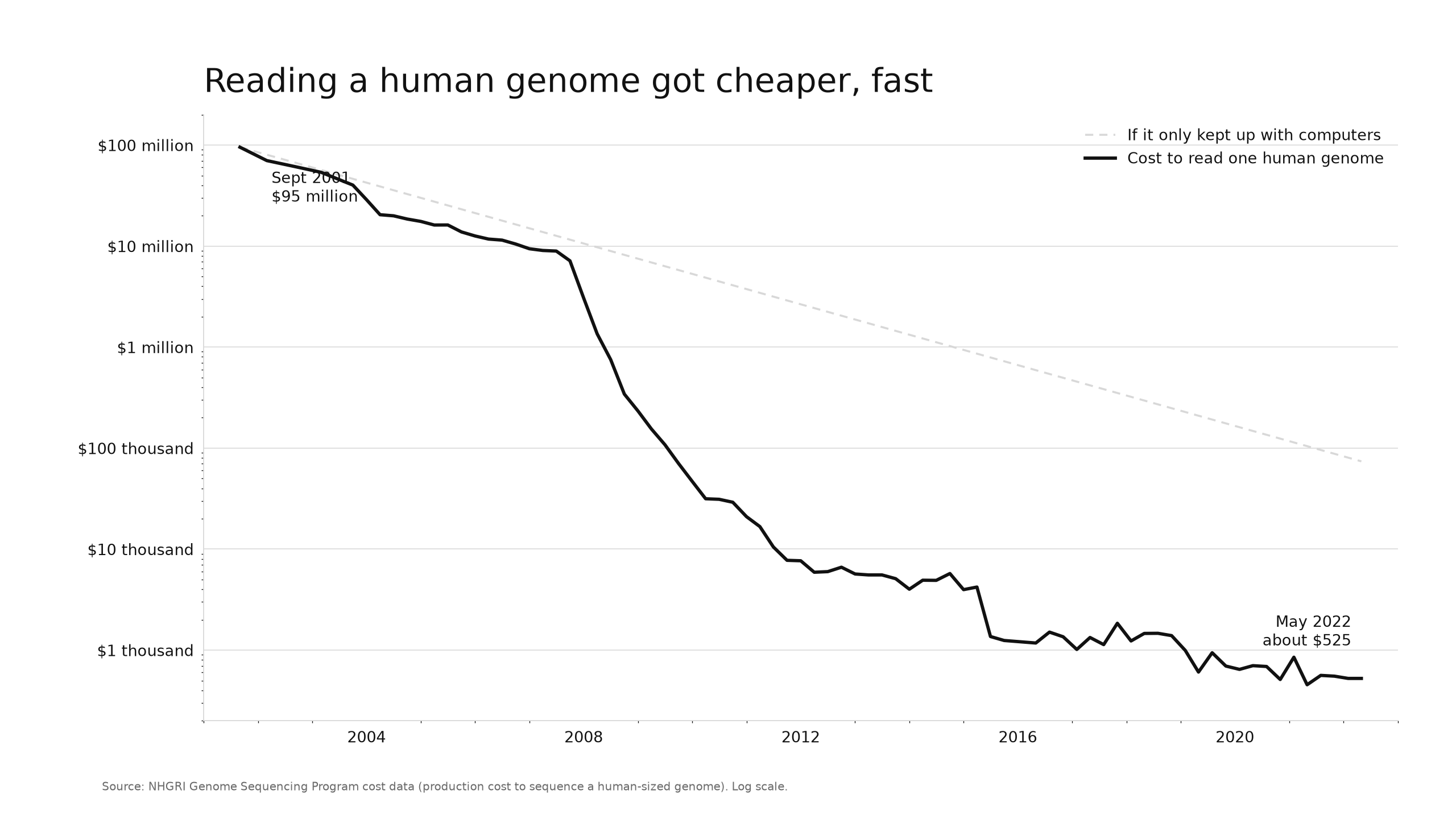
Kurzweil likes to tell the Human Genome Project story to make the shape stick. In the mid-1990s, about halfway through a planned fifteen-year effort to read the full set of human DNA, researchers had finished only about one percent of the work. Critics said the project was behind. If seven years produced one percent, they argued, finishing would take centuries. Kurzweil said the opposite. The amount of genetic data was doubling about once a year. One percent is seven doublings away from one hundred percent. On an exponential schedule, the project was right on time. Double one percent seven more times and you pass the finish line. The public working drafts arrived around 2000 and 2001, and an accurate, near-complete human genome sequence was finished in 2003, about two years early. People who expect only yesterday-plus-a-little keep underestimating a decade of change, because the early years look slow while the later years stack hard. Kurzweil’s point is not that every invention follows this curve. His point is that information technologies, the ones we copy and share as data, often do. That is the same family of tools people mean when they talk about exponential technology.
The Six Ds
Peter Diamandis and Steven Kotler walk the same road in Abundance, Bold, and their newer book We Are as Gods. They give the pattern a friendly trail they call the six Ds, so everyday readers see how a tool moves from rare lab gear to something almost everyone holds.
Digitized. The thing becomes data you share and copy. Music left the plastic disc. Photos left the darkroom. DNA and weather became files scientists open on a screen.
Deceptive. Early doublings look tiny. A digital camera that still takes soft pictures does not feel like a leap. Then the doublings stack, and suddenly the pocket camera is good enough for almost everyone.
Disruptive. The new version gets good and cheap enough that the old tool loses its everyday job. The phone replaces the separate GPS box, the paper map stack, and the bulky camera for most daily use.
Demonetized. Cost drops hard, sometimes toward free. A video call that once burned a long-distance bill now rides along with the internet connection you already have.
Dematerialized. Bulky gadgets shrink into software and apps. A 1990s luxury pile of devices fits inside one phone.
Democratized. More people get the power. Genome tools, solar panels, and phone navigation stop belonging only to labs and specialists.
Wild Abundance Is Coming
That trail is how I know Wild Abundance is coming. Wild Abundance is Calyx’s name for a future where exponential technology helps heal what has been broken, and builds more for Earth, its inhabitants, and humanity. It feels like tools that once lived in giant buildings starting to show up in ordinary days.
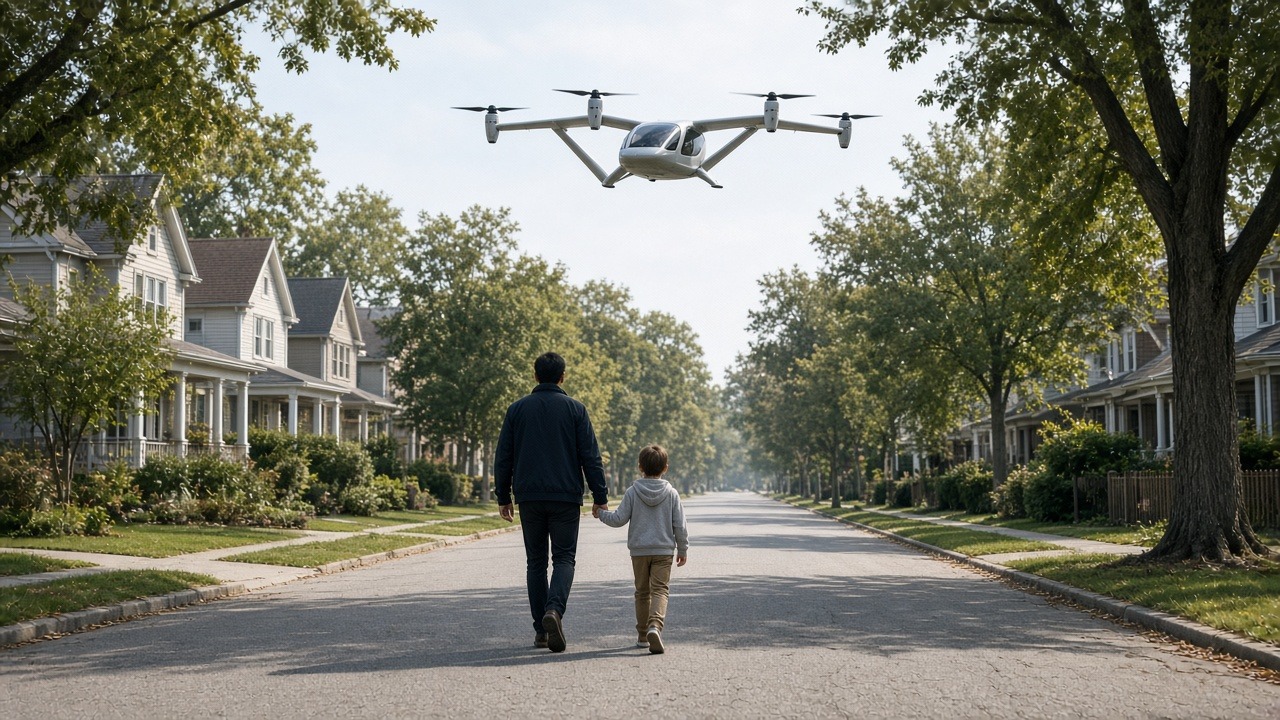
I see the next wave of everyday magic already forming in places people used to treat as pure sci-fi. Flying cars leave the movie poster and enter test routes over real cities. Companies draw plans for data centers in outer space, where sunlight and cold vacuum change the math of power and cooling. Households begin to share life with a personal robot that handles chores, and kids learn with personal AI tutors that meet them where they are, one lesson at a time. Movies get made on demand, shaped to a story you ask for, instead of waiting years for a studio slate. The same multiplying path reaches human longevity too. Some scientists predict people will soon live one thousand years or longer, if aging itself becomes a problem we learn to treat rather than accept. None of these is a finished miracle. Each one is a doubling made visible, the kind of leap that would look like magic to someone from only a short while ago.
Hope with Clear Eyes
Frameworks are not destiny. Access often lags. Old tools and jobs get squeezed when new ones take the everyday role. Tools aimed badly still hurt people. Kurzweil’s dates are not Calyx promises. Curiosity stays wiser than certainty.
Still, I watch the pattern with hope. When useful knowledge turns into shareable data, and doublings keep stacking, more people get tools that heal and build. That is the direction I want to notice and aim toward.
If you want to learn more, read Abundance and Bold by Peter Diamandis and Steven Kotler, then We Are as Gods, and Ray Kurzweil’s The Singularity Is Nearer. They will give you a fuller map of the doublings. Calyx is here for the everyday feeling of what comes next: smarter, calmer, and ready for wild abundance in ordinary days.